
The rise of AI art generators has made it easier to create stylized images and video content. Even so, each generator approaches creativity differently —some emphasize precision and control, while others focus their AI artwork generation workflow on flexibility and exploration.
EHentai AI, however, is positioned as a permissive and character-centric generator that encompasses both image generation and interactive NSFW functionalities (i.e., fantasy AI girlfriend, AI chat, and hentai sexting). Nevertheless, its performance and capabilities as an AI hentai art generator are the key considerations in practical evaluation.
EHentai AI’s Hentai Art Generator: An Overview
EHentai’s roleplay AI Chatbot, also known as eHentai.ai, presents itself as more than just a typical anime art generator. It is a generator that provides an explicit interactive experience with AI-generated adult content. It is based on a character-user workflow, whereby the idea is not simply to type a prompt and get an image, but to interact with pre-defined personalities and generate visuals around them.
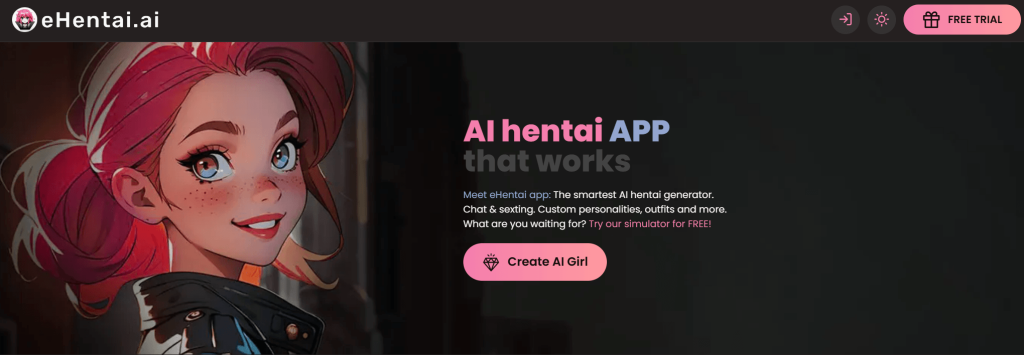
In addition, there is an underlying impression (i.e., the presence of predefined characters, categories, and personality-inspired elements) that suggests that the generator is not purely functional and that image generation is only a part of the engagement. Therefore, users are not just generating isolated images, but they are working within a system that already has its own structure.
From an objective viewpoint, however, it is permissive, stylized, and focused on anime aesthetics. Moreover, the emphasis here is not on realism or technical precision, but on producing expressive, hentai art characters that reflect the theme and mood that the user selects or specifies. And all that with relatively few restrictions.
Taken together, eHentai’s web-based AI hentai app appears to be a flexible, accessible, and easy-to-use generator that offers creative freedom in the form of personalized AI interactions.
A Character-Centric Approach to AI Artwork Generation
EHentai AI art generation clearly differs from that of other NSFW AI generators. Its workflow does not start with an empty canvas and a simple prompt box like most generators do. Instead, users are welcomed with a collection of pre-defined characters and categories, each with their own look, personality, and style —and all you have to do is choose.
The experience is then shifted from pure creation to selection and exploration, whereby the starting point is not an idea alone, but also in character identity.
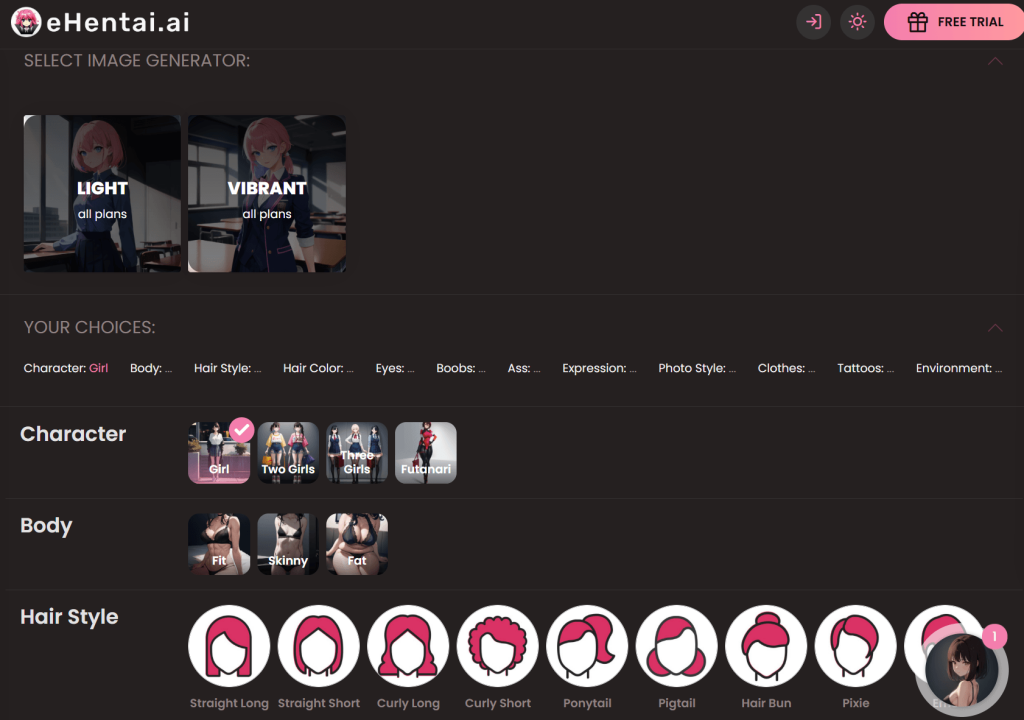
This approach defines how users perceive the generator from the outset. The interface itself appears clean and approachable, but beneath that simplicity is a more structured system that revolves around character presets. Each character comes with an implied appearance, style, and personality, which subtly influences the type of images that users can generate from them (i.e., you pick a character that fits your intent and shape/build the outputs from there). Therefore, users do not have to think too hard about prompts or prompt structure. What they do is to guide and tweak prebuilt elements.
In a way, the generator is more accessible and easier to use. However, there is a drawback because the creative process will be partially limited to the system’s existing character library. And that raises the question of whether it is a fully open AI hentai art generator, or it is a curated but interactive adult content environment.
Overall, eHentai.ai is a character-driven system, and image generation is only one part of its broader interaction model.
How the AI Hentai Art Generator Was Evaluated in Practice
EHentai AI’s hentai art generator was tested practically and beyond surface-level impressions. It was evaluated based on how it behaves under different types of input, how consistent the outputs are, how much control the system gives users when they make requests, the extent of its capabilities in hentai art generation, as well as its downsides.
Moreover, the evaluation centered on two main starting points. First was generating images using the tool’s predefined characters, which reflects how the tool is naturally designed to be used. The second involved pushing beyond that structure with more direct prompts to see how much flexibility the system allows. This made it possible to observe whether the generator prioritizes character identity or prompt instruction when the two begin to conflict.
Prompt variation was also tested. Simpler prompts were compared against more detailed and layered descriptions to see how the system interprets complexity. This was done to check if adding more detail improves the results or if it simply introduces more unpredictability. In addition, similar inputs were used to generate multiple outputs repeatedly to examine how consistent the results would be across different attempts.
Style consistency was also observed across the categories. And since the workflow revolves around predefined identities, it was important to see whether those identities maintain a stable visual appearance or shift significantly with each generation. Moreover, this ties directly into how reliable the tool is for producing accurate and repeatable results.
Finally, the overall usage flow was taken into account (i.e., how often the outputs needed to be regenerated to achieve a usable result) because it provides a more realistic picture of the generator’s efficiency, not just in terms of what it can produce at its best, but how often it actually produces remarkable results in regular use.
Character System: The Foundation of eHentai.ai Art Generation
EHentai.ai’s art generation is defined by its character system. The generator organizes its content around pre-existing characters and categories, each with its own visual identity and implied traits. And this structure plays a central role in how images are produced.
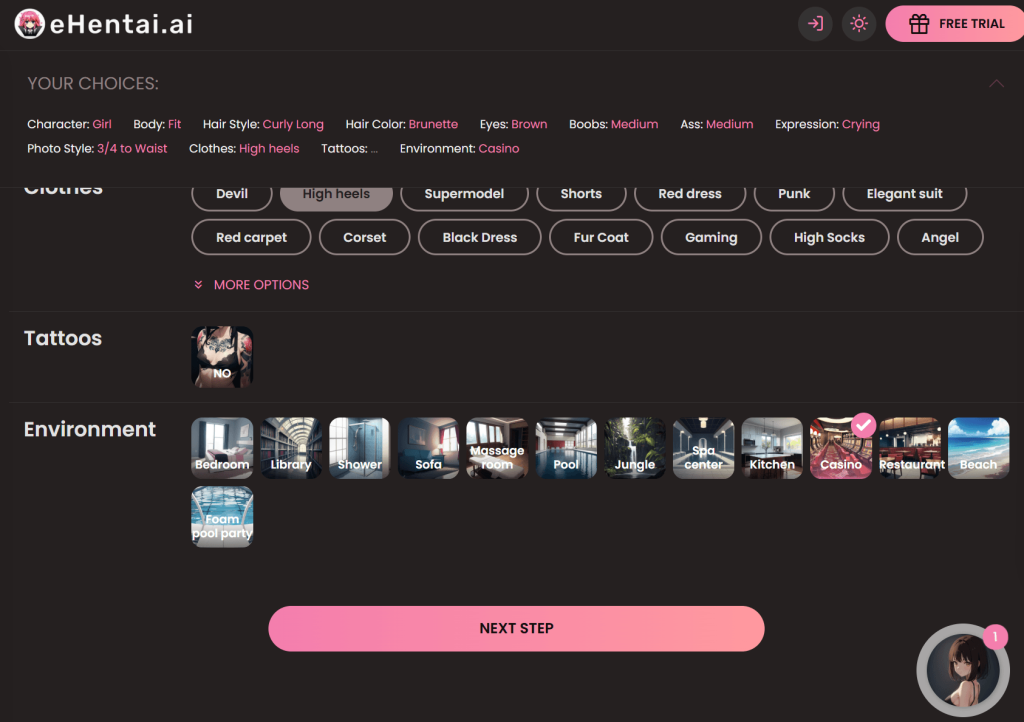
In addition, users do not generate these adult-related artworks from a blank state, but use the system’s character presets as a foundation. This means that the elements (e.g., appearance, styling, and even overall tone) are already partially determined before any prompt is applied. Therefore, the generator interprets your prompts or requests and blends them with the selected/existing character profile before it produces the results.
Even so, this has a noticeable effect on how much control is actually available to users. Because, on one hand, it helps to maintain a certain level of visual coherence, whereby the characters stay within a recognizable style, and the outputs are more polished and consistent in terms of aesthetic direction. On the other hand, however, it also limits how far the output can diverge from that baseline —flexibility. So, when one attempts to significantly alter a character’s appearance or push beyond their established style, it results in an aberrant transformation that deviates from norm, intent, idea, or imagination.
On the upside, the category system reinforces this structure by grouping the characters into different themes or archetypes that guide the type of content that can be created with each character. This makes exploration easier, but it also means that the generator will operate within a curated range rather than an entirely open space.
Indubitably, the character system is a core layer that defines the performance of eHentai.ai as an art generator. It is not just an added feature.
Creating Custom AI Characters: Prompts and Profiles
A personalized section of EHentai AI also allows users to create their own AI “girls.” The idea is that if a desired character is not already available, it can be built from scratch and then used for both interaction and image generation.
In practice, this process is not driven purely by a single text prompt in the way traditional AI image generators operate. Instead, users get to define aspects of the character such as its appearance, personality, and overall identity, and the system uses the information as a point of reference. This character then becomes a reusable entity that can generate in-chat images and participate in conversations.
Navigating EHentai AI’s Categories: Its Breadth and Depth
The eHentai AI generator includes a “category” interface. These categories make it easier to navigate the generator by acting as entry points into different types of characters, styles, and themes.
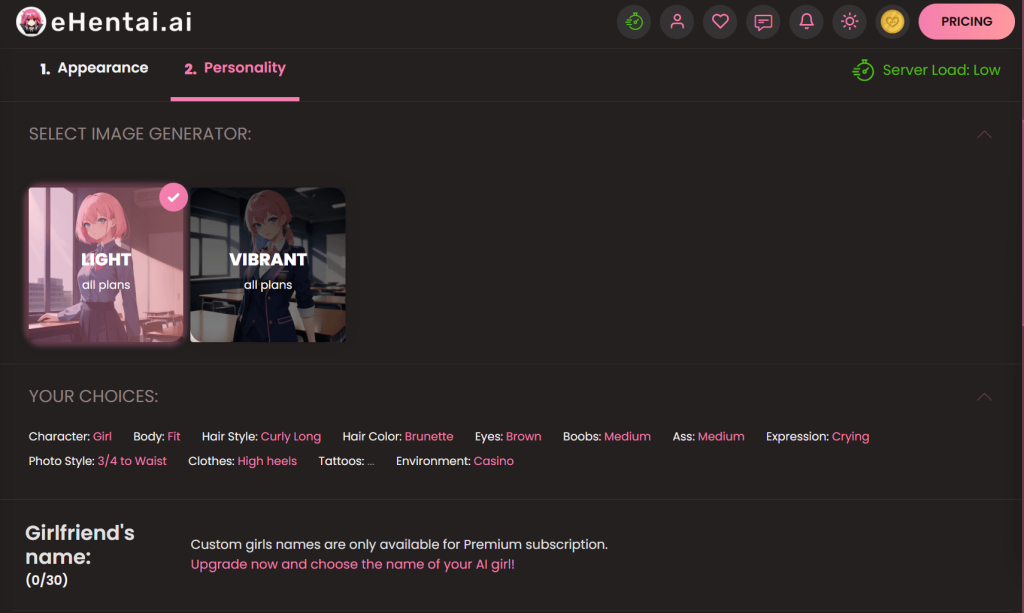
From character to body type to hair style to hair colour to eyes to boobs to ass to expression to photo style to clothes to tattoos to stockings and swimsuit to nude to environment to AI porn and to fictional characters, the category system covers it all. More so, each category has at least 3 subcategories, reaching up to over 215+ subcategories in all.
At a glance, the range is broad, and there are multiple categories to explore, each presenting a different set of characters with distinct visual directions and underlying traits. This makes eHentai.ai appear as a wide creative space where users can move between different styles and ideas (i.e., users are not limited to a single type of output).
Moreover, the category system only provides breadth. So, there is also a depth factor. When users use eHentai AI more frequently and over a prolonged period, they might realize that many of the characters share a common stylistic basis. As a result, the outputs from different categories may come off as variations of one core design. Therefore, while the categories are varied on the surface, the underlying outputs may not be as diverse as one might expect.
This does not make the system ineffective, but it does define its limits. The category structure is useful for organization and discovery (i.e., helping users to find starting points). However, it does not fully expand the generator’s range as much as it initially suggests.
In practice, the category system works best as a navigation tool rather than a source of deep creative diversity.
Prompt Behaviour: Freedom in Input, Interpretation in Output
EHentai AI is an explicit, anime adult content generator. Therefore, prompt input, whether simple or detailed, goes through without much resistance. On the surface, this gives the impression of a highly flexible generator that allows a wide range of creative directions.
However, accepting a prompt is not the same as executing it properly. The system treats most prompts (i.e., in-chat image generation requests) as suggestions. So, instead of following every detail precisely, it interprets the overall idea or intent but misses some elements or nuances.
More so, when the prompts are short and simple, the system has less to reconcile, and the outputs usually stay closer to expectations. But as prompts become more detailed, the results vary, and the final image may sometimes come out as a partial interpretation.
Image Generation Performance and Precision
When it comes to actual image output, eHentai AI shows a clear strength.
This strength, however, is closely tied to a narrower range of performance because the system handles simpler compositions much better than complex ones. As a result, single-character images are cleaner and more stable than scenarios that involve multiple characters and elements. And as the complexity increases, flaws such as inconsistent proportions, awkward positioning, or missing details become more common and noticeable.
There is also a difference between the result’s visual appeal and its structural accuracy. Some outputs may look good on the surface, but upon closer inspection, imperfections in anatomy or composition will be revealed. From a firsthand viewpoint, these drawbacks are not that severe, but they occur often enough to affect the overall reliability of the generator, especially for those looking for precise results.
Ultimately, eHentai.ai produces good and stylized hentai characters (as long as the detail is moderate).
Output Quality Assessment: Best-Case Results vs. Everyday Outputs
At its best, eHentai.ai’s characters are polished and expressive. These are the kinds of outputs that are closely similar to what the generator promises (i.e., well-rendered characters, balanced colours, and a strong sense of style). And when the composition is simple and focused, the generator delivers complete and intentional artworks.
In real use, however, these best-case results are not the default outcome. The quality of the characters tends to vary from one generation to another in everyday use. So, while many outputs remain visually acceptable, there can still be inconsistencies in areas such as detail clarity, proportions, and overall composition. More so, there can be instances where the images may appear refined at a glance, but upon closer inspection, the results may be flawed.
Most times, variation in your results is often due to complexity or character choices. Not only that, but firsthand use also confirms that a simple character setup will produce a more reliable result. In addition, your choice of character is just as important because the system maintains more visual stability with some presets than others.
More so, there is also an element of randomness in each generation (i.e., even similar inputs can produce noticeably different outputs).
Therefore, the generator can provide high-quality results, but they are not consistently achievable, or guaranteed.
Consistency and Repeatability: Variation as a Feature (and Limitation)
Consistency is where EHentai AI begins to show one of its more defining trade-offs. Generating the same image twice (i.e., even with identical prompts and the same character) rarely produces identical results. Each run introduces subtle or sometimes noticeable differences that make the system appear dynamic, but also less predictable.
EHentai AI portrays this variation as a feature of the generator, not a flaw or a software bug. In this context, the system’s variability works in favour of exploration, and it makes experimentation much easier and more flexible for users. That way, the generator produces fresh interpretations each time a prompt is repeated (i.e., multiple generations can lead to different visual outcomes without needing to constantly adjust the prompt).
At the same time, this lack of consistency becomes a limitation when precision is required. It becomes difficult to refine a specific result or recreate a particular image once it has been generated.
On eHentai.ai, variation is prioritized over consistency.
Effort vs. Outcome: How Much Work It Takes to Get a Good Result
EHentai AI makes NSFW artwork generation accessible and quick. However, getting a good output is rarely a one-step experience.
In many cases, the first generation usually captures the general idea but falls short in execution. Therefore, one might find small inconsistencies in structure, missing details, or slight deviations from intent on the first try. As a result, multiple retries are inevitable. Even so, one has to generate as many variations as possible until one stands out.
This trial-and-error (iteration) pattern defines much of the workflow, because a usable image is often the product of several attempts and not the direct outcome of a single well-constructed input. In that sense, the generator rewards persistence more than precision.
There is also a balance between randomness and control. And since variation can sometimes lead to unexpectedly good results, it can just as easily produce outputs that drift further away from the original idea. So progress is not always tied to clearer inputs or better prompts.
Frankly, satisfying results cannot be engineered on eHentai.ai; it can only be discovered through multiple attempts, small adjustments, and a degree of patience.
Token System, Daily Rewards, and Real Usage Flow
The token system is at the heart of eHentai AI —it manages the usage of the generator. Users need tokens to interact (i.e., chat, sext, and make requests) with the character. Therefore, image generation, along with other forms of interaction, is tied to how many tokens are available to the user at any given time.
Moreover, the generator introduces a daily reward system, the Daily Claim Bonus Program, to keep usage active. To start with, every new user receives 10 messages after onboarding, and by returning/logging in every day, they get an additional 1 message. By accumulating additional messages over time (i.e., one message per day), one’s capacity to interact with the system increases, reaching up to 50 messages by the end of the 40th day. But only as long as that consistency is maintained and the login streak is unbroken by users.
There is also a referral program in place. Although it is for premium users only. It offers additional tokens when new users join through an existing account —the new user gets 50 tokens, and the existing user who sent the invitation link gets 100 tokens. This part of the experience encourages participation and growth within the ecosystem.
Taken together, the real flow of usage on eHentail.ai is paced by tokens, rewards, and engagement loops. And it results in a system where access is available, but not entirely unrestricted, and where the cost of generating multiple outputs is measured not just in time, but in available resources.
Chat and Roleplay System: How It Connects to Art Generation
At its core, eHentai AI is an interactive NSFW application for chatting, sexting, and roleplay with AI-generated anime characters, and this plays a crucial role in how images and other artworks are created. The generator allows users to interact with AI characters through messaging, and these characters are designed with personalities, behaviours, and conversational context —they are not just visual templates.
The artwork/image generation functions, however, are not a separate process. Because the artworks are influenced by the identity of the character being interacted with (i.e., how they look, how they behave, and how they are presented feeds directly into the type of images that are generated). Basically, eHentai AI blends interaction and creation. It does not treat them as independent features.
The roleplay functionality creates a loop whereby user interaction with a character informs the generation process, and the generated result reflects the interaction. This is not always precise; however, its influence will be noticeable in output framing and styling.
Taken together, eHentai.ai is best seen as a character ecosystem where hentai artworks are shaped by both prompts and interaction.
Final Verdict
EHentai AI presents itself as a highly permissive generator that emphasizes freedom, personalization, and immersive interaction.
On the surface, these claims are not entirely misplaced because the system truly does allow a wide range of inputs, it offers character-driven experiences, and produces visually appealing anime-style outputs under the right conditions.
In practice, however, the generator is capable but not tightly controlled. It can produce good results, but not consistently. It accepts most ideas, but does not always execute them fully. And this creates a discrepancy between what is promised and what is reliably delivered.
Nevertheless, eHentai AI’s strengths lie in its openness and variety because it encourages exploration, which allows for multiple creative directions and offers a level of freedom that many more restrictive tools do not.
In the end, eHentai AI is best understood as a flexible and expressive system, not a precise one. Users can interact with it, experiment, and generate interesting results, but it does so by trading away consistency, control, and reliability.