The most common mistake beginners make is treating an AI hentai generator like a search engine. They type in something like “A beautiful anime girl on a bed” and wonder why the result looks generic or slightly off. In 2026, the best creators don’t use sentences; they use what’s called “weighted data blocks.”
Wondering what that is? Not to worry. Think of a weighted data block as a priority list for the AI’s brain. Instead of trying to parse the grammar of a sentence, the AI looks at individual tags, like “blonde hair” or “cinematic lighting”, and then assigns them a numerical value or weight. By using these blocks, you aren’t just asking for an image; you are telling the AI’s neural network which specific data clusters to prioritize and how much influence each one should have over the final pixels.
Because most hentai models (like Pony Diffusion V6 or Illustrious XL) are trained on tagged image boards like Danbooru, they respond best to comma-separated keywords. To get professional results, you need to master the art of the Structured Prompt.
The Core Formula: The Four-Layer Cake
A professional-grade prompt is built in layers. By organizing your tags in this specific order, you help the AI anchor the most important elements first.
Layer 1: Quality Anchors.
These tell the AI to look at the masterpiece section of its brain. In 2026, the meta for Pony-based models requires a very specific string: score_9, score_8_up, score_7_up, score_6_up, score_5_up, score_4_up.
Pro Tip: Due to a quirk in the training of V6, you must include the _up suffix. Using score_9 alone is significantly less effective than using the full descending string. This forces the model to stay within the highest-rated data clusters.
Layer 2: The Rating and Source.
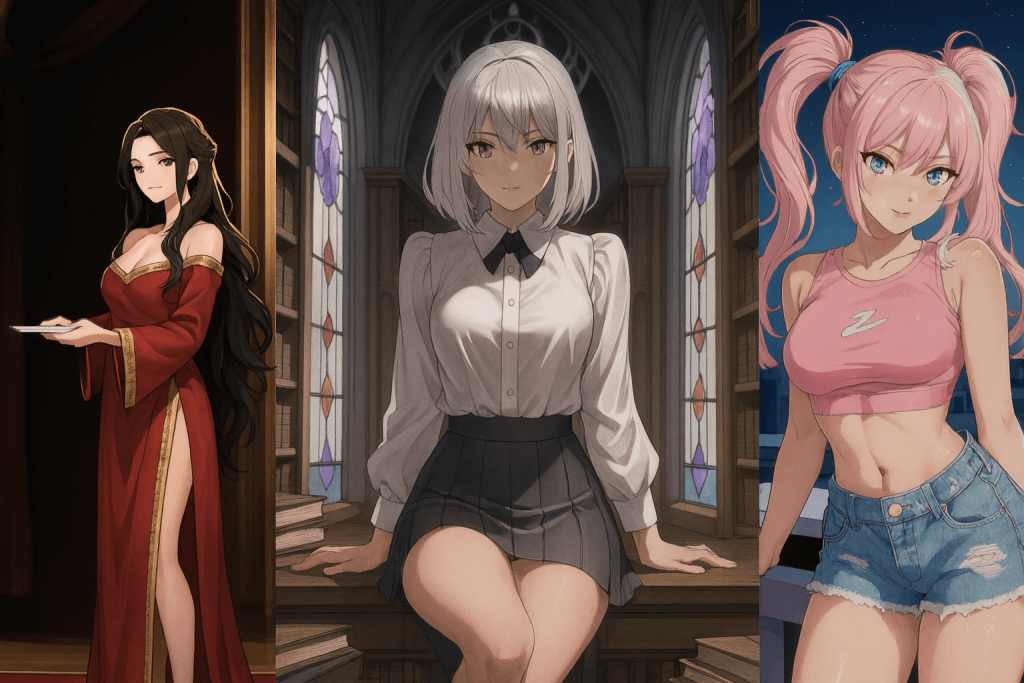
Define the intent of the image. Use: rating_explicit, source_anime, source_pony. This tells the AI to favor hand-drawn aesthetics over 3D or claymation styles.
Layer 3: The Subject & Pose.
Define the character and the physics. Use: 1girl, solo, long hair, blue eyes, [character name], lounging, legs apart, hand on hip.
Layer 4: The Vibe & Lighting.
Define the film”quality. Use: cinematic lighting, rim lighting, atmospheric, detailed background, indoor, sunlight.
The Power of Prompt Weighting
In 2026, you aren’t limited to just listing tags. You can tell the AI exactly how much you care about each one.
- The Parentheses Rule: If the AI is ignoring your character’s red eyes, use (red eyes:1.2). This increases the weight of that tag by 20%.
- The Bracket Rule: If a feature is too strong (like an oversized chest), use [large breasts] to slightly decrease its influence.
- The Nudge: If you want a mix of two things, say, a mix of a maid outfit and a superhero costume, you can use [maid outfit | superhero costume]. The AI will alternate between the two during the rendering process, blending the styles.
The Negative Prompt: The Boundary Box
The negative prompt is arguably more important than the positive one. It tells the AI what to exclude. If you leave this blank, you are practically asking for extra fingers and blurry faces.
- The Anatomy Shield: extra limbs, extra fingers, mutated hands, bad anatomy, disfigured, fused fingers, missing limbs, disconnected limbs, [fewer digits].
- The Quality Filter: lowres, bad quality, worst quality, normal quality, jpeg artifacts, signature, watermark, username, blurry, cropped, error.
- Style Control: If your anime images look too much like 3D CGI, add 3d, realistic, photorealistic, cgi, render to the negative prompt to force it back into a 2D hand-drawn look.
Advanced 2026 Techniques: Aesthetic Scoring
By early 2026, the best models have been trained with Aesthetic Ranking. This means you can use specific years or Artist Styles to force the AI into a more modern look.
- The Year Tag: Using year 2025 or year 2026 in your prompt forces the AI to use modern high-fidelity art styles, avoiding the dated look of 2022-era AI.
- The Style Trigger: In 2026, many creators use (style of [Artist Name]:0.8) to capture a specific line-weight or shading style without completely copying the artist’s work.
Anatomy of a Master Prompt: A Deep Dive
To truly understand effective prompting, let’s deconstruct a professional Prompt Block.
- The Positive Prompt:
score_9, score_8_up, score_7_up, rating_explicit, source_anime, 1girl, solo, (highly detailed skin:1.2), (intricate eyes:1.1), long flowing blue hair, white sundress, standing in a sunflower field, golden hour, rim lighting, (masterpiece:1.2), cinematic composition, 8k resolution
Why it works: It starts with the Quality Anchors to set the resolution high. It then uses Weighting (1.2) on the skin and eyes to ensure the AI doesn’t blur those details. It finishes with Environmental Tags (sunflower field, golden hour) to provide a cohesive color palette.
- The Negative Prompt:
(low quality, worst quality:1.4), (bad anatomy), (extra limbs), (fused fingers), (monochrome), (greyscale), text, watermark, signature, blurry, 3d, realistic, cgi, (bad hands:1.2)
Why it works: It heavily penalizes low quality (1.4), making it almost impossible for the AI to choose a low-res data path. It also blocks 3D and realistic to ensure the Anime source is the only one used.
The Evolution of Natural Language vs. Tagging
As we move toward 2027, models are becoming better at Natural Language. You can start to say things like, “A girl wearing a red dress, looking away from the camera.” However, in the hentai niche, Tagging remains superior.
Why? Because tagging allows for Niche Precision. Terms like zettai ryouiki (the “absolute territory between socks and skirts) or ahegao are incredibly specific data points that Natural Language often fails to capture accurately. By using Booru tags, you are accessing the specific sub-folders of the AI’s training data.
Troubleshooting Your Prompts
If your images are coming out burnt (too high contrast) or messy:
- Lower your CFG Scale: If it’s at 10, try 7. High CFG forces the AI too hard toward your prompt, causing digital artifacts.
- Check your Weights: If you have too many (tag:1.5) markers, the AI gets confused about what to prioritize. Keep weights between 0.8 and 1.3.
- The Sampling Check: Ensure you are using the right sampler. In 2026, DPM++ 2M SDE Karras is the gold standard for high-detail hentai art.
Conclusion: Mastering the Machine
Effective prompting is a conversation. You give a command, the AI gives a result, and you nudge it until it matches your vision. By using the Four-Layer Formula, mastering Weighting, and using a robust Negative Prompt, you stop gambling with the RNG (Random Number Generation) and start acting like a Director.
The Golden Age of AI art is here. You have the power to create professional-grade hentai in seconds; you just have to learn to speak the language of the machine.